

Gastric Sleeve or Gastric Bypass: Which Is Right for You?
Sleeve gastrectomy and gastric bypass are the two weight-loss operations people compare most often, and neither is simply better than the other. The right choice depends on your weight, your health conditions, your eating habits and how you feel about lifelong supplements. This guide explains how the operations differ and which questions to bring to a surgeon, so that the decision is made on your medical picture, not on a price tag.
How a sleeve and a bypass work differently
In a sleeve gastrectomy the surgeon removes a large part of the stomach and leaves a narrow tube, or sleeve. The food path stays the same, but the stomach holds much less, and many people also feel less hungry after surgery because the part of the stomach that produces much of the hunger hormone is removed.
A gastric bypass works in two ways. The surgeon creates a small stomach pouch and connects it directly to a lower part of the small intestine, so food bypasses most of the stomach and the first section of the intestine. Less food fits in, and fewer nutrients are absorbed. The classic version is the Roux-en-Y bypass; a mini, or one-anastomosis, bypass uses a single connection instead of two.
There are also operations that combine both principles, such as SADI-S, usually discussed for patients with a very high BMI or when a previous operation did not give enough result. Today these procedures are normally performed laparoscopically, through a few small punctures rather than one large incision, which generally makes the first days after surgery easier.
Who is a candidate for bariatric surgery

Bariatric surgery is meant for people with severe obesity who have not been able to lose weight and keep it off by other means. A common threshold, and the one City Medical Centre states on its site, is a BMI above 40, or above 35 when there are serious related conditions such as type 2 diabetes, high blood pressure or sleep apnoea.
BMI is only the starting point. A surgeon will also want to know about your eating patterns, previous diets, medication, heart and lung health and any history of stomach problems. Expect blood and urine tests, an HbA1c test for blood sugar and checks by other specialists before a date is set. Smokers are asked to stop at least a month before surgery, because smoking slows healing and raises the risk of ulcers and other complications.
It also helps to be honest with yourself about readiness. Surgery changes the size of your stomach, not your habits, so ask whether psychological support or a dietitian is part of the programme. People who prepare for the new way of eating before the operation usually find the first months much easier.
Reflux, diabetes and other factors that shape the choice
Several health questions often tip the balance between the two operations, which is why the choice should come from a surgeon who has reviewed your history.
- Reflux. A sleeve can make existing heartburn worse in some people, while a bypass is often considered when reflux is already a significant problem.
- Type 2 diabetes. Both operations can improve blood sugar, but a bypass is frequently discussed for people whose diabetes is harder to control.
- Vitamins and medication. After a bypass, absorption changes for life, so daily supplements and regular blood tests become permanent. Some medicines are also absorbed differently.
- Previous abdominal surgery. Adhesions or earlier operations on the stomach can influence which technique is safer.
- Eating habits. Frequent snacking or sweet drinks can undermine either operation, and a surgeon may weigh this when advising you.
Write these points down with your own details before the consultation. A surgeon who explains why one operation suits you better, and what the drawbacks are, is giving you far more useful advice than one who simply recommends the option that is cheaper or quicker to book.
Life after surgery: diet stages, vitamins and activity
The operation is the start of the process, not the end of it. Patients usually walk on the first day and stay in hospital between one and five days, depending on the procedure and how they recover. Office work is usually possible after two to four weeks.
Eating returns in stages over one to two months:
• liquids first, taken slowly in small sips;
• then soft and pureed food;
• then solid food in small portions, chewed carefully.
Moving to the next stage too quickly can cause pain, vomiting or problems at the staple line, so follow the plan you are given. Protein becomes a priority at every meal, and many people learn to stop eating at the first sense of fullness.
After a bypass, vitamins and minerals are needed for life, and blood tests show whether the doses are right. After a sleeve, supplements are also commonly recommended, so ask your surgeon what applies to you. Regular follow-up in the first year helps catch problems early and keeps weight loss on track.
Having bariatric surgery abroad: timing, cost and follow-up
If you are considering surgery in another country, plan the trip around recovery. Travel home is usually best arranged no earlier than about a month after the operation, and the exact timing should be agreed with your surgeon. Make sure you know who follows you up once you are back and how you can reach the team with questions.
As one example, City Medical Centre in Moscow describes its sleeve, Roux-en-Y bypass, mini bypass and SADI-S procedures on its weight-loss surgery page with sleeve and bypass options. At the time of writing (September 2026) a sleeve gastrectomy is listed from $3,600 (previously $4,800) and a gastric bypass from $4,000 (previously $5,200). The clinic offers a free first consultation, which can be held online, says that its team follows patients up during the first year, and fixes the exact cost in the contract after the consultation.
Whichever clinic you choose, ask for a written plan covering the tests before surgery, the length of the hospital stay, the diet stages and the supplements you will need. Questions the website does not answer, such as accommodation or travel support, belong with the coordinator before you book anything.











г. Москва, Можайское шоссе, д.4, к.1
О клинике
В нашей клинике работают только российские врачи с лицензиями и ответственностью в соответствии с законодательством РФ. Здесь вас ждет самое современное оборудование, а врачи регулярно проходят курсы повышения квалификации. Мы заботимся о наших пациентах, поэтому предлагаем для них всегда наилучшее решение в их случае. Также мы регулярно проводим Акции и Спецпредложения и вы можете получить услуги клиники и комплексные предложения с выгодными скидками.
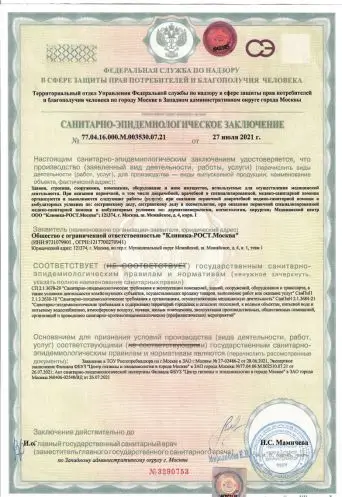
Лицензия на осуществление медицинской деятельности: Л041-01137-77/00336927 выдана Департаментом здравоохранения города Москвы.
Нужна консультация? Свяжитесь с нами:
+7 (499) 550-34-95
doctor@clinic-rost.ru
Москва, Можайское шоссе 4, корпус 1