

Beyond the Knee: Regenerative Injections for Shoulder, Elbow and Ankle
Most writing about PRP and SVF injections focuses on knees, because knee osteoarthritis is so common. Yet shoulders, elbows and ankles cause just as much daily trouble: a shoulder that aches at night, an elbow that hurts when lifting a kettle, an ankle that never quite recovered from a sprain. This article looks at how regenerative injections fit these joints and what a proper assessment involves.
Why smaller joints deserve their own approach
Each joint has its own anatomy and its own typical problems. The knee is a weight-bearing hinge, and most of its trouble comes from wear of cartilage and menisci. The shoulder is the most mobile joint in the body and relies heavily on tendons and muscles to stay stable. The elbow is dominated by tendon overload, and the ankle by ligament injuries and their after-effects.
That difference matters for any injection treatment. A needle placed a few millimetres off target in a shoulder may end up in the wrong layer entirely, and the same pain can come from the joint, a tendon or a bursa. Diagnosis has to be precise before anyone decides what to inject and where.
It also means expectations differ. A joint with early cartilage wear may respond differently from one where the main problem is a degenerated tendon next to it.
PRP, made from your own blood, and SVF, made from a small sample of your own fat, are used across several joints for this reason. Neither is a universal fix, but both can be part of a plan when the diagnosis is clear and the stage is early to moderate.
The shoulder: pain when lifting the arm and at night
Shoulder pain often appears when raising the arm above head height, reaching behind the back or lying on the affected side. Common causes include irritation or wear of the rotator cuff tendons, inflammation of the bursa above them, early arthritis of the main shoulder joint or of the small joint at the top of the shoulder.
Physiotherapy is usually the first line, because strengthening the muscles that centre the shoulder takes pressure off irritated structures. When pain persists despite that, an injection may be considered. PRP is often discussed for degenerative changes, where it may help calm inflammation and create better conditions for tissue repair. SVF tends to be considered when joint changes are more pronounced and a longer-lasting effect is the aim.
Precision is critical in the shoulder. Ultrasound guidance lets the doctor see the needle reach the joint space or the targeted area rather than guessing from surface landmarks.
A complete tendon tear, a frozen shoulder in its painful early phase or severe arthritis may need different treatment, sometimes surgical. An honest doctor will say so.
The elbow and the wrist: overload and early wear
Elbow pain is frequently linked to repeated strain: gripping tools, typing for long hours, racket sports or lifting at work. Pain on the outer side, known as tennis elbow, and on the inner side, known as golfer's elbow, involve the tendons attached there rather than the joint itself. Arthritis of the elbow joint is less common but does occur, especially after old fractures.
Rest from the triggering activity, physiotherapy and changes in technique or equipment come first. Injections may be considered for persistent symptoms, and regenerative options are attractive to many people because they use their own material rather than steroids.
The hand and wrist joints are a separate group. Arthritis at the base of the thumb or in the wrist can make simple tasks like opening jars or turning keys painful. Here too, early stages respond better to conservative and injection approaches than advanced, deformed joints.
In all of these, an imaging assessment comes first. An ultrasound often shows tendon problems well, while an X-ray or MRI is more helpful when cartilage and bone are involved.
The ankle: after sprains and with early arthritis
Many ankle problems begin with a sprain that was never fully rehabilitated. Repeated instability can damage the cartilage of the ankle joint over time, leading to stiffness, swelling after walking and pain on uneven ground. Ankle arthritis also develops after fractures that involved the joint surface.
The first steps are sensible footwear, balance and strengthening exercises, and sometimes an ankle support for demanding activities. When pain and swelling continue, regenerative injections may be discussed as an option for early to moderate changes.
As with other joints, the procedure is planned around imaging. Ultrasound guidance ensures the material is placed into the joint or the targeted structure, which is particularly important in the ankle, where the space is narrow and surrounded by tendons.
Pain usually eases gradually over the first month after treatment, mobility improves over about three months and the full effect develops over roughly six months, though individual responses vary. If the joint is already severely worn or unstable, other treatments, including surgery, may be the more realistic route.
Getting a precise diagnosis and a second opinion
Before considering any injection, gather the information that shows what is going on: recent X-rays, an MRI or ultrasound report, and the images themselves if you have them. Add a short description of your symptoms, when they started and what you have already tried.
Several clinics now review scans remotely. City Medical Centre in Moscow, for example, offers a free review of X-rays, MRI or ultrasound sent before the visit, and lists the shoulder, elbow, ankle, hand and wrist alongside the knee and hip on its page on PRP and SVF for different joints. There is also an English page for Australian patients with joint pain. The treatment is done in one day, without a hospital stay, with follow-ups after one, three and six months, and the doctor says openly when joint replacement is the more realistic option.
Contraindications include cancer, pregnancy and breastfeeding, clotting disorders, acute infections, a flare of a serious chronic illness and serious heart, kidney or liver disease. Fever or skin inflammation over the joint means postponing.
Whatever you decide, start with a diagnosis you understand.



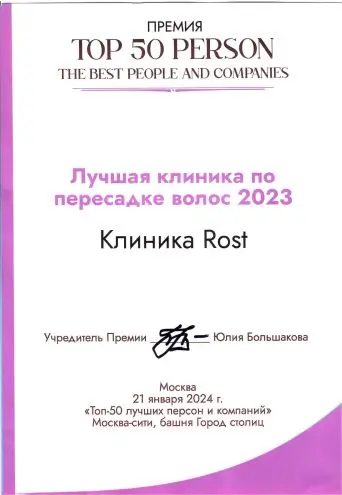







г. Москва, Можайское шоссе, д.4, к.1
О клинике
В нашей клинике работают только российские врачи с лицензиями и ответственностью в соответствии с законодательством РФ. Здесь вас ждет самое современное оборудование, а врачи регулярно проходят курсы повышения квалификации. Мы заботимся о наших пациентах, поэтому предлагаем для них всегда наилучшее решение в их случае. Также мы регулярно проводим Акции и Спецпредложения и вы можете получить услуги клиники и комплексные предложения с выгодными скидками.
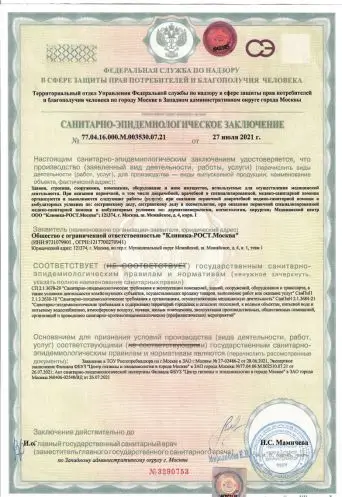
Лицензия на осуществление медицинской деятельности: Л041-01137-77/00336927 выдана Департаментом здравоохранения города Москвы.
Нужна консультация? Свяжитесь с нами:
+7 (499) 550-34-95
doctor@clinic-rost.ru
Москва, Можайское шоссе 4, корпус 1